
upgr8
From Collective Input to Actionable Intelligence
Outline

Vienna

Web Application


Challenges
Turning unstructured input into structured intelligence
Crowdsourcing only works when participation is easy. The moment it feels like filling out a form, drop-off spikes. And the output only matters if leadership trusts it enough to act on it. Those two requirements pulled in opposite directions throughout the project.
Getting both right introduced a set of problems without obvious answers.
The hardest parts we tackled:
- Model reliability for AI categorisation: Language models don't all perform equally when classifying and clustering ideas. We ran systematic comparisons to identify which models held up most consistently, and built validation logic to flag low-confidence outputs.
- Latency vs. participation UX: AI processing takes time. The participation flow has to feel instant. We mapped exactly which enrichment steps happen in real time and which run in the background, so participants never wait while the analysis layer still gets full depth.
- Testing without real data: There was no existing dataset to build against. Synthetic data helped, but it introduced its own biases and masked edge cases that only real human input surfaces. We built flexible tooling to iterate quickly once early live usage began, and treated the first real runs as extended test cycles.
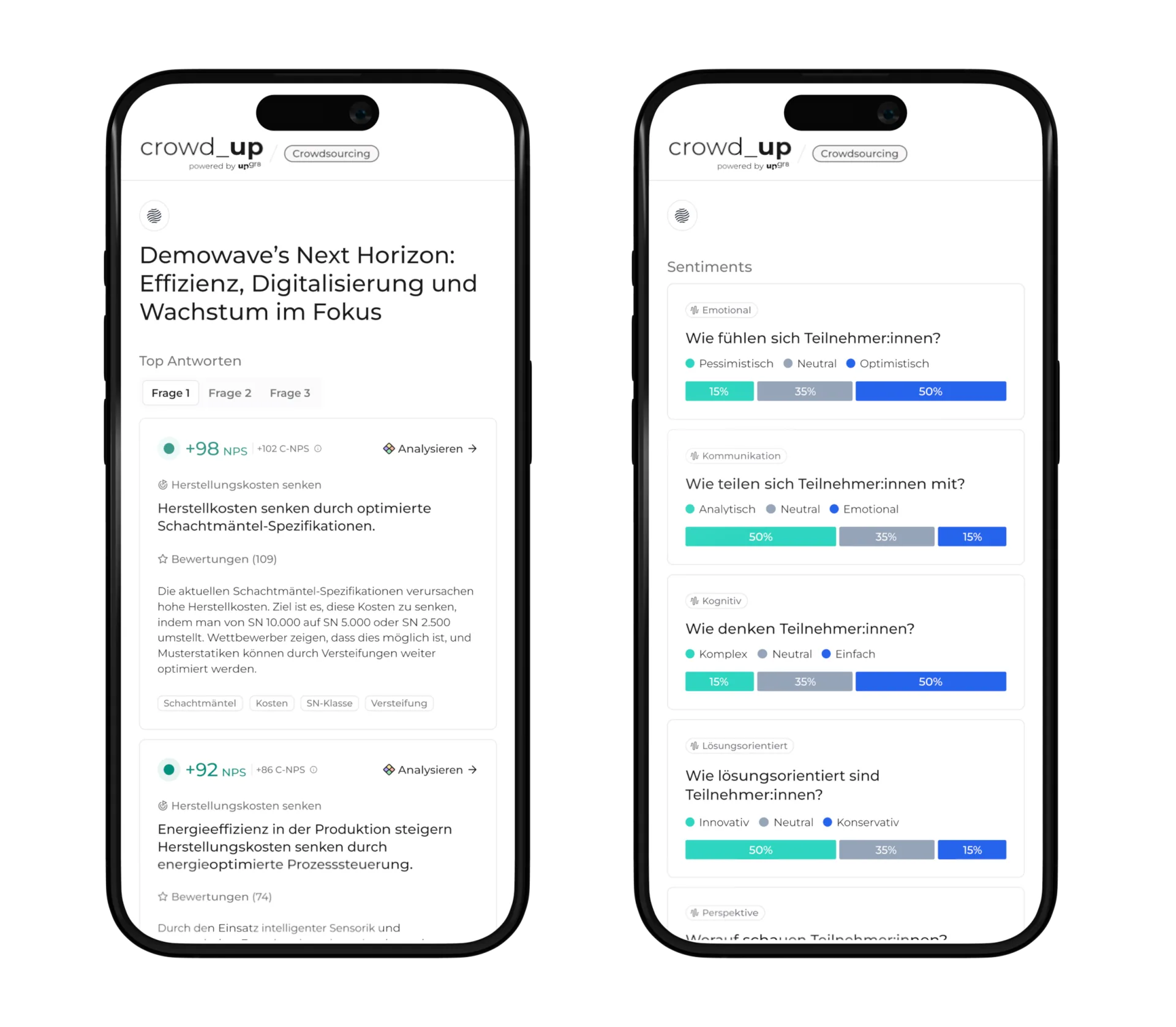
- Fair rating distribution: Popular ideas attract more attention, which means more votes, which makes them look stronger than they are. We designed a distribution logic that counteracts this, surfacing ideas for rating based on thematic balance rather than recency or popularity.
- Stakeholder alignment across a complex product: crowd_up touches organisational dynamics well beyond the software. Multiple stakeholders had different expectations for what good output should look like. Getting alignment on what the platform should and shouldn't do at launch required structured facilitation alongside the product work.
Objectives
AI-powered analysis, without structures that bias the result
The goal was a crowdsourcing platform that extracts genuine organisational insight from free-form input. Participants contribute without templates. The system makes sense of it afterwards.
The architecture is built around the enrichment pipeline from the ground up. How ideas enter the system, how they get categorised and clustered, how clusters evolve as more input arrives, and how that analysis gets translated into something readable at the executive level.
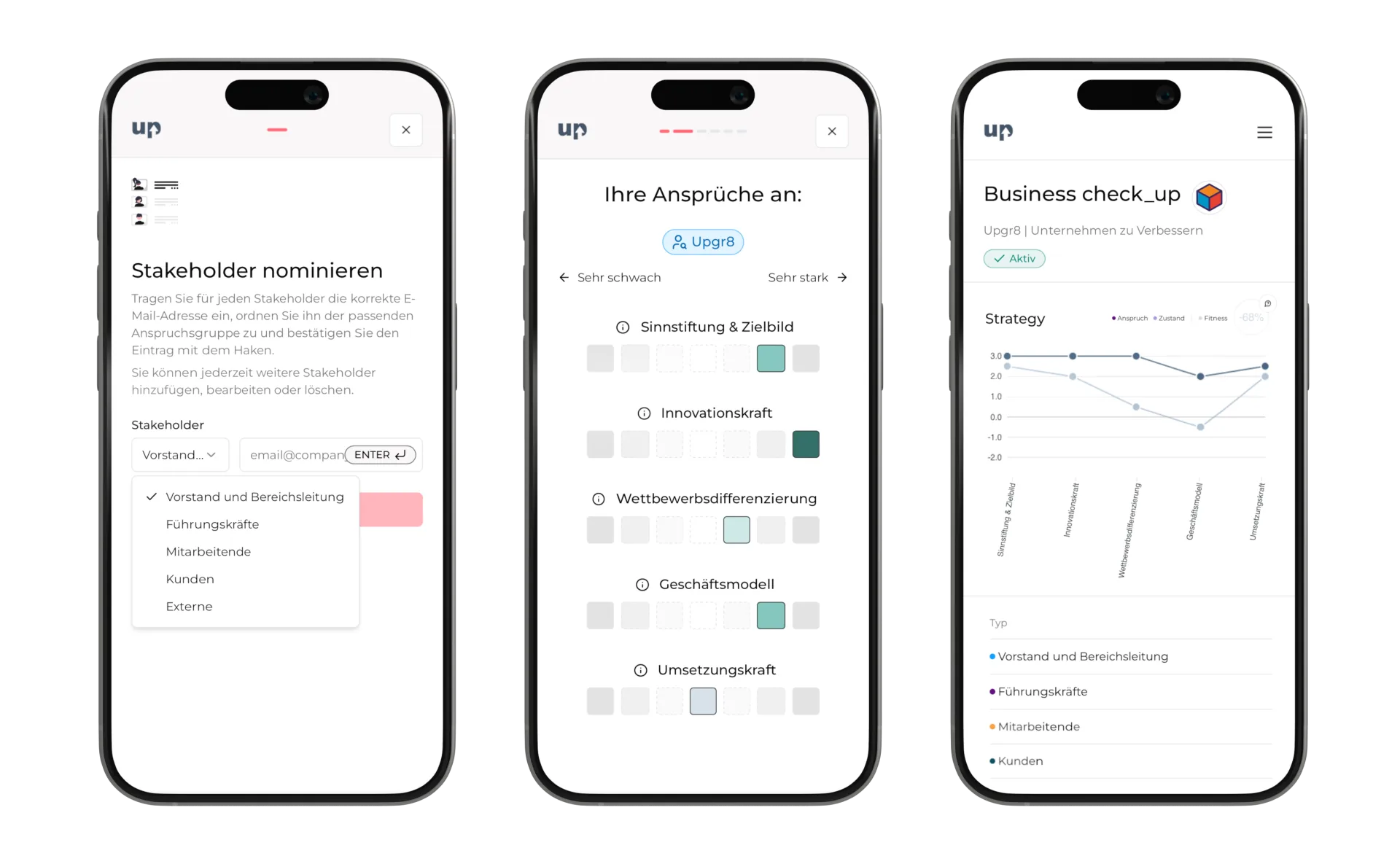
High participation matters for signal quality. A crowdsourcing platform that's hard to join, or that feels like a survey, undermines the whole point. The UX had to be fast and low-barrier.
To deliver on both requirements, we chose a stack suited for this kind of workload. Laravel provides the application foundation, with the Laravel AI SDK handling AI interactions cleanly without custom integrations for every model call. Vue.js powers a reactive frontend that keeps the participation flow fast and responsive. PostgreSQL was chosen for its native vector support, which powers the similarity searches behind the clustering logic. Background processing runs through Laravel's queue system, so enrichment and analysis happen asynchronously without blocking the user experience.
Connecting the dots
Organisations generate more collective intelligence than they can access. The tools that exist to surface it are either too rigid or too manual to be useful at scale. crowd_up was built to close that gap. Participation is effortless, analysis is automatic, output is immediately actionable.
The three features that define the platform each solve a distinct part of the problem.
The enrichment pipeline as the platform's backbone
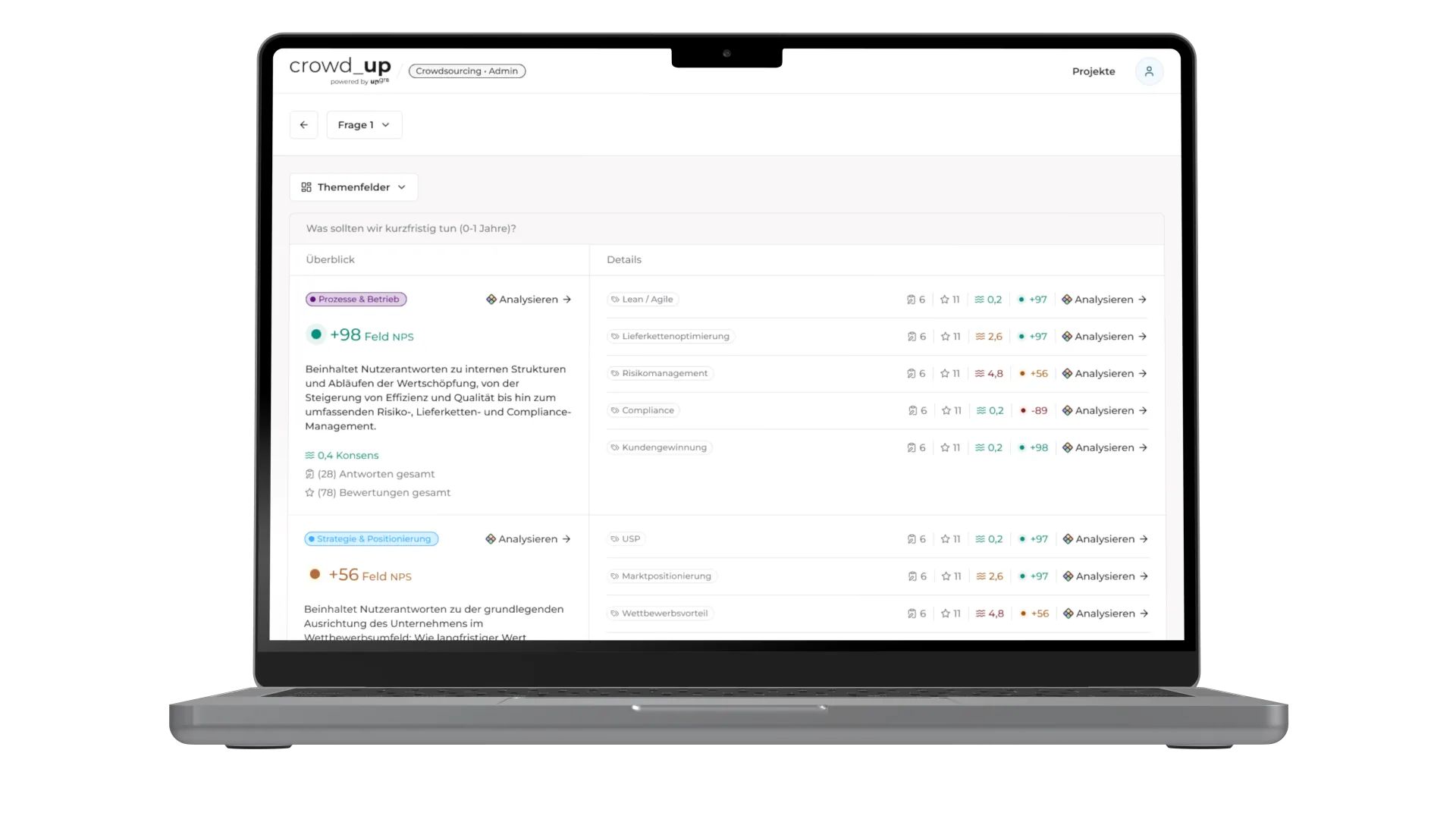
When an idea enters crowd_up, it gets processed immediately. The pipeline categorises it, compares it against existing clusters using vector similarity search, and either places it within an existing theme or seeds a new one. No manual tagging. No moderation overhead.
As participation grows, the analysis gets richer. Themes emerge from the data. Organisational blind spots that no single person would have named become visible through the pattern of what many people independently raise.
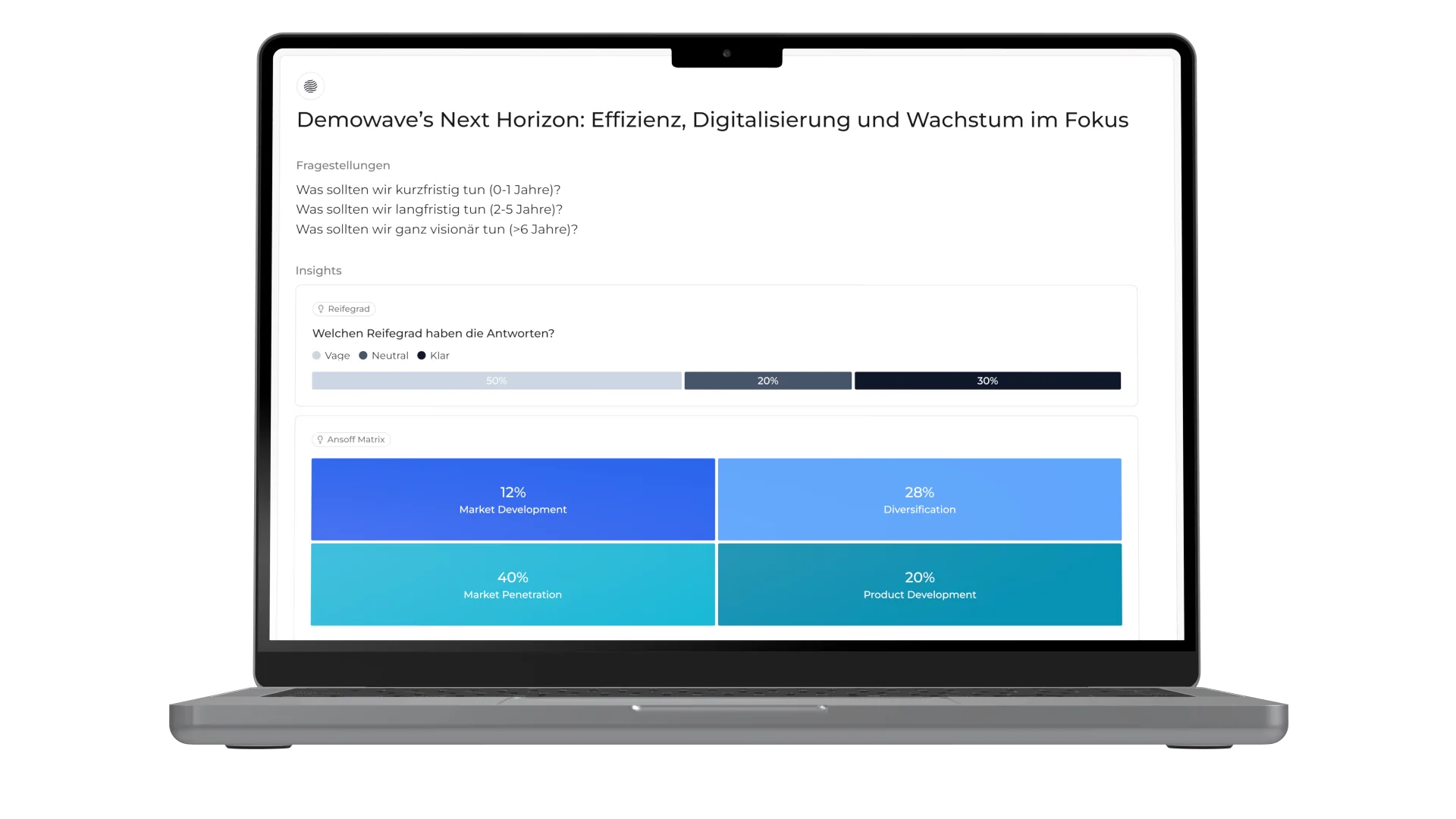
The Executive Summary gives leadership a structured, plain-language digest of key themes, cluster strength, and where the most signal is concentrated. No long session with export files required. The Rating Process ensures every contribution gets a fair hearing, with distribution logic that surfaces ideas by thematic balance rather than recency or popularity.
From raw input to real decisions
The enrichment pipeline, executive summaries, and rating process create a loop. Contribute freely. See it make sense. Trust the output. Act on it.
That loop gives organisations a genuine collective intelligence capability. One that compounds as participation grows and clusters deepen over time.
The result is a platform that makes crowdsourcing useful at the organisational level, beyond the team level. Leadership gets structured output they can act on immediately. Contributors get a process that feels worth their time. And the organisation gets a clear view of what its people actually think.

It was the best IT project I've ever experienced
Everything we specified got delivered. What stood out was how proactive the project management was throughout. No chasing, no surprises. Dotbite delivered ahead of schedule and was genuinely easy to work with. It was the best IT project I've ever experienced.
Armin Blassnig, CEO upgr8
Achievements
3.500+
ideas & rating of ideas
82
NPS satisfaction of product users
epunkt
We partnered with epunkt to build a modern job and client platform on a stable technical foundation, fully integrated with Salesforce as the single source of truth.
Fixmetall
Your small-scale steel or metal is one click away. Discover over 10,000 products and have them precisely delivered straight to your home.
NextPlace
NextPlace is our own product. It connects to a company's ATS, prepares every job for machine reading, and publishes it where candidates now search. Inside ChatGPT, Claude, Gemini, Copilot, Grok and Perplexity.
Zurich - LiLi
The LiLi application is a fast application to classify, index and validate documents across different input channels.
Digitale Tennisschule
Manage training sessions, coaches, players, courts and your tennis school as a whole. From training planning to billing with just a few clicks.
LEAD Horizon - Alles Gurgelt!
LEAD Horizon wanted to bring highly intuitive, safe and fast PCR testing into people’s homes. We developed the Web App that made “Alles Gurgelt” possible.
whoranks
In a world where LinkedIn has become a central place for networking, branding, and thought leadership, understanding your influence and engagement on the platform is crucial.
Vengolino - Vienna Red Cross
Tasty, healthy & personal, "Vengolino" for short. The food ordering app from the Vienna Red Cross.
timebite
timebite is a crowd-based learning platform where students share their learning tips for exams and reflect on their learning behavior through individual statistics.
Quinn - TU Vienna
Quinn is a native ECTS evaluation app that we developed together with the Vienna University of Technology to improve ECTS equity and studyability.