
NextPlace
From Your ATS Into AI Search
Outline

Vienna

Web Application


Ongoing

Challenges
Eight ATS, different ways in
Every applicant tracking system exports jobs differently. Some have a documented REST API. Some only publish an XML feed built for job boards. Some push webhooks. Some offer nothing beyond a career page. Building one clean pipeline on top of that variance was the core of the project.
The hardest parts we tackled:
- Different connection types, one data model: REST APIs, feeds, webhooks and career page crawling deliver different fields, different HTML quality and different update semantics. We normalise all of them into a single job record before anything else happens, so the enrichment pipeline never has to know where a job came from.
- Keeping the ATS in control: Recruiters work in their own system and should keep working there. A position closed in the ATS has to disappear from distribution within minutes, without anyone opening NextPlace. Polling intervals, webhook handling and crawl scheduling are tuned per connection type to make that hold.
- Writing for machines without writing worse for humans: Raw ATS text is inconsistent. Marketing copy, formatting leftovers, missing salary data, locations written five different ways. The pipeline has to produce something a language model can quote accurately while staying true to what the employer actually wrote.
- Proving that any of it works: AI visibility is hard to measure. There is no ranking position to screenshot. So we built access logging that separates machine traffic from human traffic per job, down to which crawler read which position and when.
Objectives
Visibility in AI search, with no extra work for recruiters
The promise had to stay simple. Connect your ATS once, change nothing about how your team works, and your jobs become readable for the systems candidates now ask.
That put two requirements at the centre of the architecture. Setup had to be a one-time job measured in minutes. Everything after that had to run without a human in the loop.
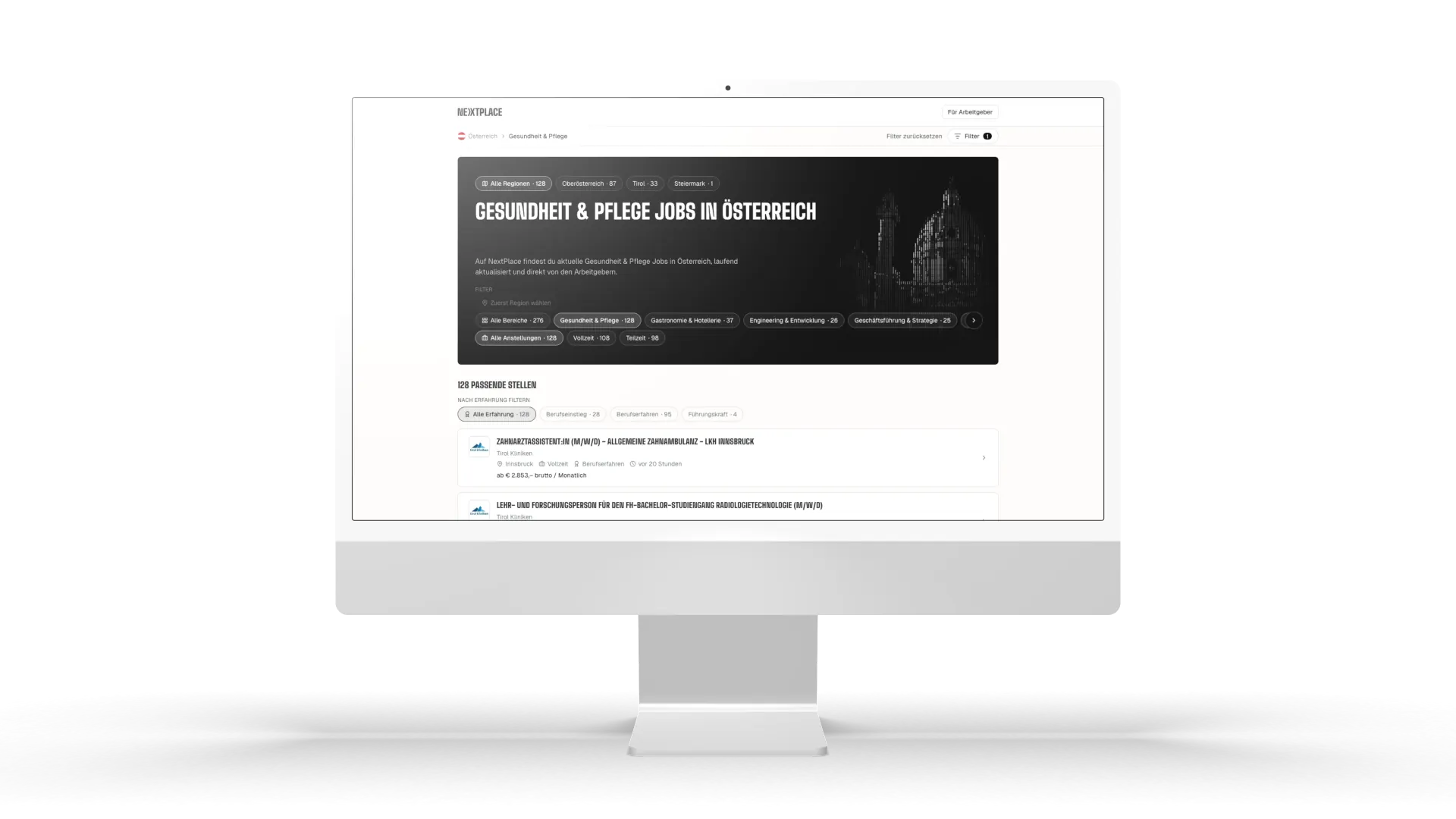
Each position passes through the same pipeline. It gets cleaned and structured, enriched with schema.org JobPosting metadata covering salary, location and working model, and extended with generated questions and answers that mirror what candidates actually ask. The result is published on pages built to be read by machines, alongside agent-readable endpoints and explicit crawler handling, so answer engines get the facts in a form they can quote instead of guessing from rendered HTML.
We built NextPlace on Laravel with Inertia and Vue.js, the same foundation we use for large web applications. Server-side rendering carries more weight here than anywhere else, because a crawler that has to execute JavaScript is a crawler that will not see the job. Tailwind carries the UI, and sync and enrichment run through Laravel's queue system, so imports never block the interface.
Connecting the dots
Candidates changed where they ask. Recruiting software did not follow. A job ad that lives inside an ATS and a JavaScript career page stays invisible to the systems that now answer career questions.
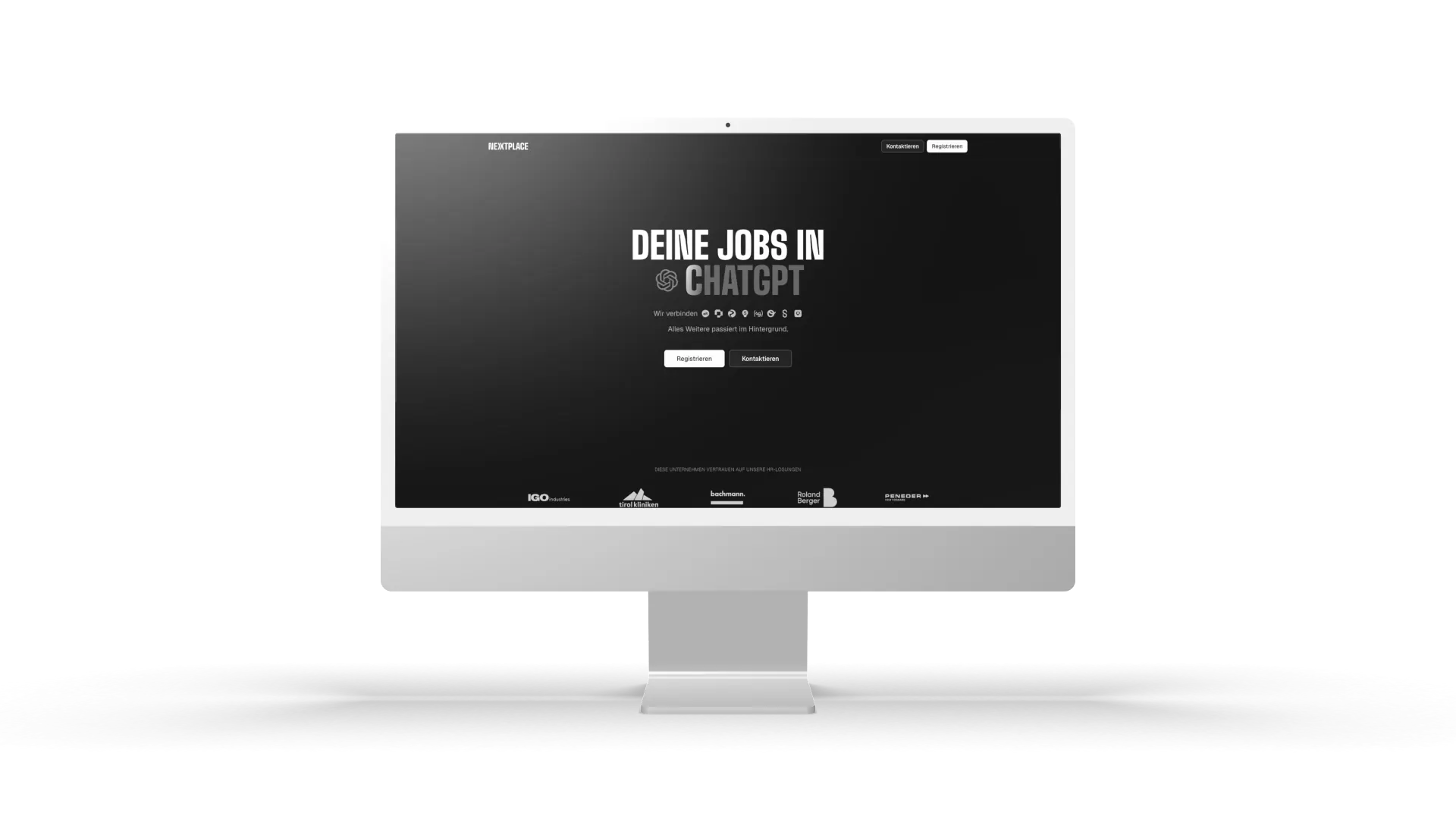
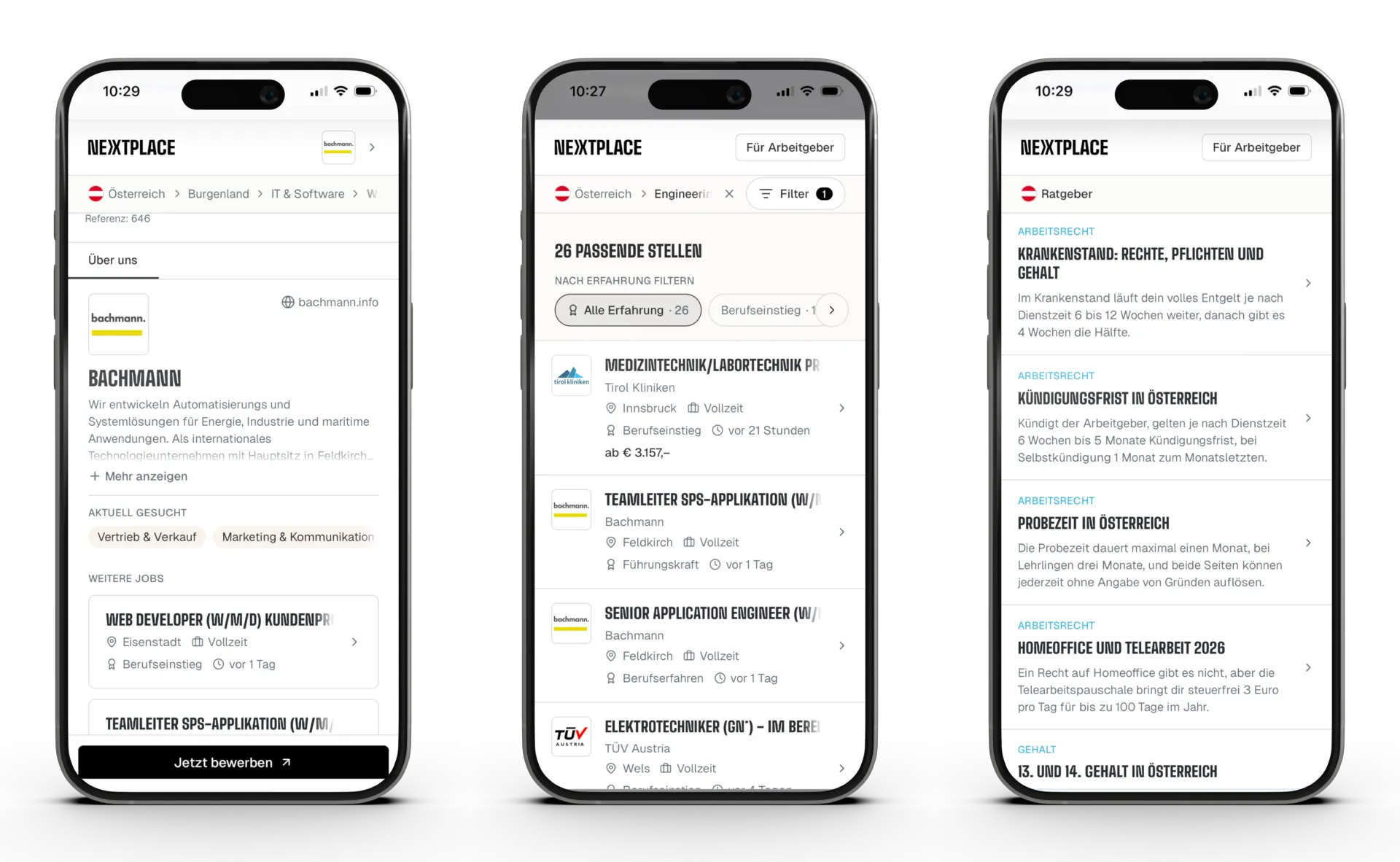
NextPlace sits between those two worlds. Eight ATS connections on one side, six AI channels on the other, and a pipeline in between that turns a raw job record into something a machine can read and quote. The three parts that define the product each solve a different piece of it.
One connection, different ways to make it
The integration layer is what makes the rest possible. A REST API where the ATS offers one, a feed where it does not, webhooks where the system pushes, and a crawler for career pages that expose nothing else. Every path ends in the same normalised job record, which turns adding the next system into an integration task instead of a rebuild.
The enrichment pipeline takes that record and prepares it for machine reading. Structure, metadata, JobPosting schema, and generated questions and answers per position. The reporting layer closes the loop, separating machine access from human access per job, so every customer sees each month which AI systems read which position.
What the pilot shows
First customers are live and connected. Their jobs sync out of the ATS without anyone changing a workflow, run through the pipeline, and get read by AI crawlers. The monthly report makes that traceable down to the single position.
HR is not new ground for us. timebite puts employer branding profiles in front of students and graduates, matched to what they study. NextPlace is our own product in the HR space. It came out of a change in where candidates ask their questions.
For us, NextPlace is the work we usually do for clients, applied to our own product. Concept, design, AI development, full-stack build and API integrations, shipped as one thing that runs in production. The recruiting side of it stays boring on purpose. Connect once, keep working the way you always did, and let the pipeline handle the rest.
epunkt
We partnered with epunkt to build a modern job and client platform on a stable technical foundation, fully integrated with Salesforce as the single source of truth.
Fixmetall
Your small-scale steel or metal is one click away. Discover over 10,000 products and have them precisely delivered straight to your home.
Zurich - LiLi
The LiLi application is a fast application to classify, index and validate documents across different input channels.
Digitale Tennisschule
Manage training sessions, coaches, players, courts and your tennis school as a whole. From training planning to billing with just a few clicks.
LEAD Horizon - Alles Gurgelt!
LEAD Horizon wanted to bring highly intuitive, safe and fast PCR testing into people’s homes. We developed the Web App that made “Alles Gurgelt” possible.
whoranks
In a world where LinkedIn has become a central place for networking, branding, and thought leadership, understanding your influence and engagement on the platform is crucial.
Vengolino - Vienna Red Cross
Tasty, healthy & personal, "Vengolino" for short. The food ordering app from the Vienna Red Cross.
timebite
timebite is a crowd-based learning platform where students share their learning tips for exams and reflect on their learning behavior through individual statistics.
Quinn - TU Vienna
Quinn is a native ECTS evaluation app that we developed together with the Vienna University of Technology to improve ECTS equity and studyability.
