
Gemini just became Google's fastest growing product ever
Gemini crossed a billion monthly users this week, and Google shipped the hardware to match. Anthropic started watermarking every line Claude writes because of a new EU law. Cloudflare built a browser with zero Chromium in it, just for agents. Cognition is talking to investors about a $40 billion valuation for a coding agent. And OpenAI made ChatGPT free and unlimited for text, for everyone.
Google: a billion Geminis and a $29 tracker
Sundar Pichai announced on Tuesday that the Gemini app crossed one billion monthly active users, making it the fastest growing product in Google's 28 year history and the 14th to reach that mark. The climb is worth reading in order. 400 million at I/O 2025, 750 million in February, 950 million at the Q2 earnings call on 22 July.
A day later, Made by Google landed the hardware half. Pixel 11 starts at $899 with the 2nm Tensor G6, alongside Pixel Watch 5 and a $29 Pixel Tag going straight at AirTag. Everything ships 20 August except the Tag, which waits until November.
Google spent two years looking kind of late. It now owns the model, the chip, the operating system and the phone in one stack, a position nobody else has right now. Whether a billion people chose Gemini or just found it already installed is a different question. Google has no reason to answer it.
Anthropic: your Claude output now carries a signature
Anthropic confirmed in an updated support page that it will watermark text generated by its models. Every model released after 2 August embeds a watermark automatically, with C2PA used for files. It applies at the model level, so it shows up whether the text came from the API, Claude, Claude Code or Cowork. The watermark travels with copy and paste, and it can survive some editing.
The trigger is the EU AI Act Transparency Code, which took effect on 2 August and requires AI generated content to be machine identifiable. Google, Meta, Microsoft, OpenAI and Synthesia signed up to the same code. Suno started watermarking tracks last week, and Substack now runs Pangram to flag AI writing.
For anyone shipping AI-assisted copy, docs or code to clients, this is the part of the week that actually reaches your invoices. Worth deciding how you talk about it before a client asks.
Cloudflare: a browser that was never built for humans
Cloudflare launched Kitesurf last Thursday, a cloud-hosted browser runtime built for AI agents with no Chromium anywhere in it. It stitches together Blitz's modular rendering engine, Firefox's Stylo CSS parser and the Rust-based Boa JS engine, all running inside Workers. It already passes more than 215,000 web platform tests.
Cloudflare's own benchmarks put it at 3.1 to 3.8 times less CPU and 4.7 to 7 times less memory than Chromium, depending on the task. Free while it stays in beta.
Every agent stack today drives a browser built for eyeballs, tabs and themes, then pays for all of it in compute. Ripping that out is unglamorous engineering that quietly rewrites cost structures. If you run scraping or automation at any real volume, this one is worth a spike.
Cognition: $40 billion for a coding agent
Bloomberg reported on Wednesday that Cognition is in early talks to raise at a valuation of at least $40 billion. That would be a jump of more than 50% from the $26 billion it raised at in May, three months ago. The number rests on a plan to reach a $1 billion annualised revenue run rate, up from $492 million when the last round closed.
The same week, Blacksmith's valuation jumped 10x to $550 million, because AI coding is generating so much code that validating it became its own market.
Coding remains the cleanest commercial case for generative AI, since the output is countable. Shipped features, closed bugs, hours saved. A $40 billion price tag assumes agents take a genuine slice of global engineering spend rather than sitting politely next to developers. We will find out soon.
OpenAI: chat became free and endless
On 6 August OpenAI removed limits on text chats for every ChatGPT user, free tier included. GPT-5.6 Luna is now the default for Free and Go, replacing GPT-5.5, and both tiers get a Think button for harder questions. Plus and Pro get an upgraded GPT-5.6 Sol plus a thinking slider to dial reasoning up or down. OpenAI's internal evals claim factual errors dropped 62% for Luna and 68% for Sol against GPT-5.5 Instant. Limits stay on files, images, voice and image generation.
Text chat is now a free commodity at a billion weekly users. The paid tiers sell images, voice, files and reasoning depth instead. Anyone whose product is mostly a wrapper around a chat box should read that pricing page twice.
This roundup first went out to our Dotbite Tech Pulse subscribers. Want it in your inbox, too?
Frequently Asked Questions
How many monthly users does Gemini have now?
The Gemini app crossed one billion monthly active users in August 2026, making it the fastest growing product in Google's 28 year history and the 14th Google product to reach that mark. The climb went from 400 million at I/O 2025 to 750 million in February and 950 million at the Q2 earnings call on 22 July. A day later Google unveiled the Pixel 11 lineup, starting at $899, alongside Pixel Watch 5 and a $29 Pixel Tag.
Does Anthropic watermark everything Claude writes now?
Yes. Every Claude model released after 2 August 2026 embeds a watermark in generated text automatically, with C2PA used for files. It applies at the model level, so it shows up whether the text came from the API, Claude, Claude Code or Cowork, and it can survive copy and paste plus some editing. The change follows the EU AI Act Transparency Code, which took effect on 2 August and requires AI generated content to be machine identifiable.
What is Cloudflare Kitesurf and how is it different from Chromium?
Kitesurf is a cloud-hosted browser runtime Cloudflare built for AI agents, launched in August 2026, with no Chromium code in it. It combines Blitz's rendering engine, Firefox's Stylo CSS parser and the Rust-based Boa JS engine, running inside Cloudflare Workers, and already passes more than 215,000 web platform tests. Cloudflare's own benchmarks show 3.1 to 3.8 times less CPU and 4.7 to 7 times less memory than Chromium. It is free while in beta.
What valuation is Cognition raising at?
Cognition, the AI coding startup, is in early talks to raise at a valuation of at least $40 billion, according to a Bloomberg report from August 2026. That is a jump of more than 50% from the $26 billion valuation it raised at in May, three months earlier. The number rests on a plan to reach a $1 billion annualised revenue run rate, up from $492 million when the last round closed.
Is ChatGPT text chat free and unlimited now?
Yes, as of 6 August 2026 OpenAI removed limits on text chats for every ChatGPT user, including the free tier. GPT-5.6 Luna became the default model for Free and Go, replacing GPT-5.5, with a Think button for harder questions on both tiers. Plus and Pro get an upgraded GPT-5.6 Sol plus a thinking slider. Limits still apply to files, images, voice and image generation.
Get the Tech Pulse
Every month we research and write down what actually moved in tech and AI. Plus tips and tricks on how to use AI. You don't want to miss this.
Join Tech PulseYou might also like
October 14th, 2026
WordPress vs. Laravel when your website becomes an application
Bookings, member areas, forms with custom logic. When WordPress and WooCommerce hit their limit and what the move to Laravel looks like.
October 9th, 2026
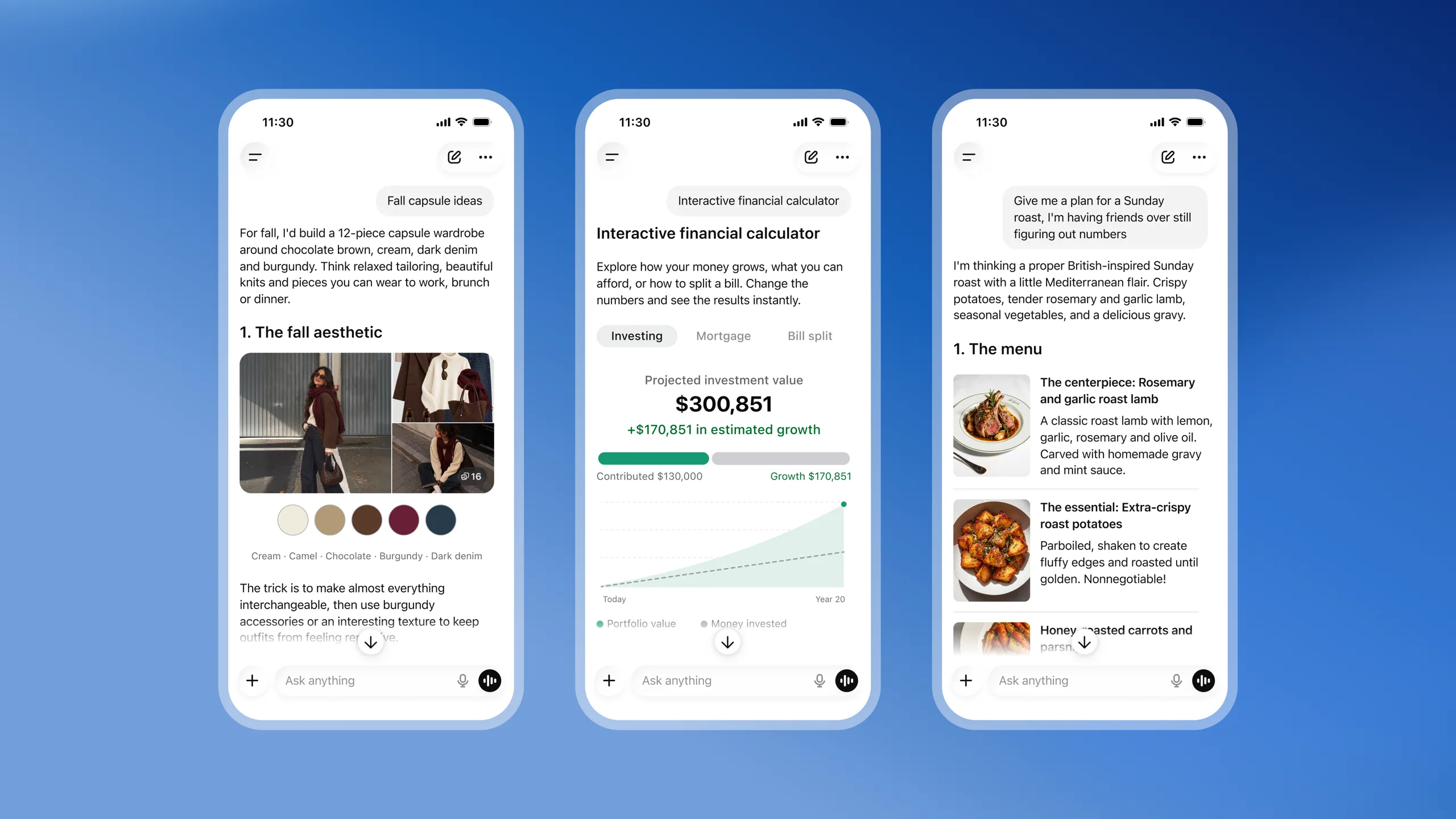
Websites are locking AI agents out at the checkout
Websites block AI agents at checkout, ChatGPT answers with Intelligent UI, Mistral Large 4 lands, Haiku 5.5 ships, and Pony.ai heads to London.
October 7th, 2026
Zapier vs. Laravel and when your own code pays off
Zapier, Make and n8n bill per task, credit or execution. When a small Laravel application becomes cheaper and more reliable, with a worked example.
Ready to connect the dots?

Hi, I’m Emir, CEO and Co-Founder of Dotbite.
You have an interesting idea for a digital project and are looking for a sparring partner pushing the challenge through with you?
You’ve come to the right place.